


By Adam Bexson, Senior Consultant
Millions of employees are now saving into workplace pensions. Yet the latest Pensions Commission interim report suggests many are still not on track for an adequate retirement.
For employers, that creates an important challenge: how do you move beyond participation and focus on outcomes?
The second Pensions Commission interim report, published in May 2026, is a useful reminder that success in workplace pensions cannot be judged by participation alone. The key question for employers is whether current saving patterns are likely to translate into adequate outcomes in later life. In many cases, there is good reason to think the answer is still some way from where it needs to be.
Is this just another white paper?
I would suggest not.
The first Pensions Commission laid the foundations for auto-enrolment, after all. While it is arguable whether auto-enrolment has been a complete success, participation has increased hugely and we know that 15 million people are still undersaving.
What is certain is that it has changed workplace pensions in the UK forever.
Undersaving remains a central challenge
The report’s estimate that millions of people are undersaving for retirement is striking, particularly given the concentration of risk among low and middle earners.
For employers, this is a useful point at which to reflect on whether minimum contribution structures are being treated as a starting point, or whether they have quietly become the assumed end point for too many employees.
The risk is that employees only recognise the gap when it is already difficult to make a significant difference.
Investment outcomes deserve more attention
The report points to two related questions for employers:
- Are employees saving enough?
- Is the money already being saved being invested in a way that gives them a reasonable chance of achieving adequate outcomes?
It is also worth noting that contributions, important though they are, represent only one side of the equation. Over long periods, investment performance can materially affect outcomes, which is why default funds warrant closer attention than they sometimes receive.
For a large proportion of employees, the default fund is not simply a fallback option; it is, in effect, their retirement strategy.
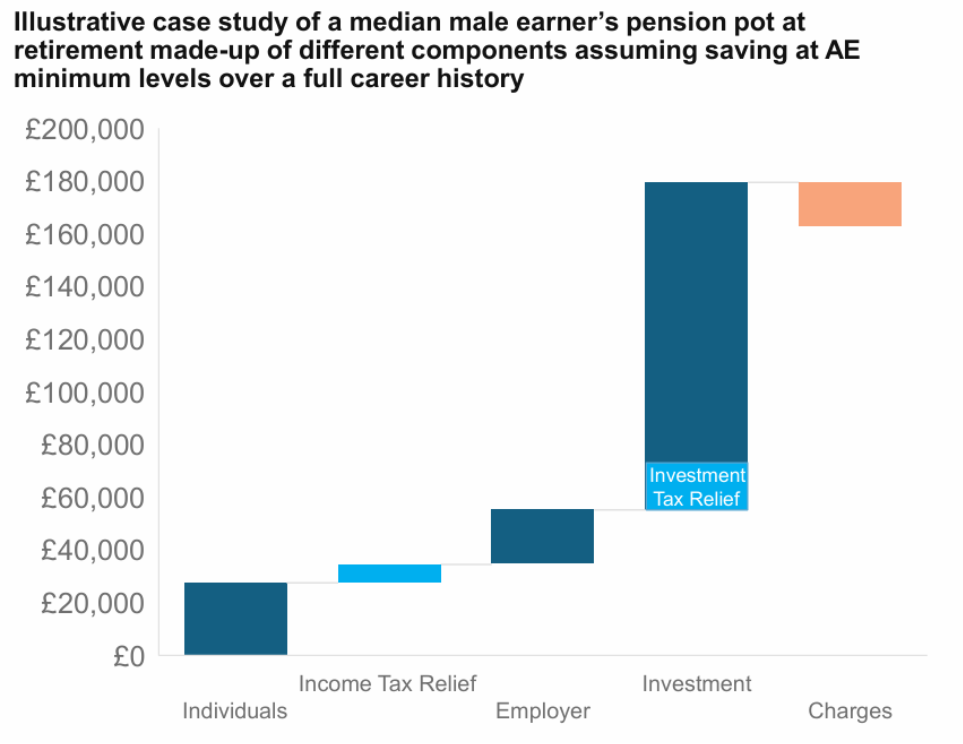
The report underlines how significant this can be, suggesting that even a modest improvement in annual returns could have a meaningful impact on retirement outcomes over time. Looking at an average earner, the importance of investment is quantifiable, and shown in the graphic below.
Simply put, investment returns for a saver account for the largest proportion, by far, of an individual’s defined contribution pension pot at retirement. Part of this is due to the power of compounding. The report suggests that 1% higher returns could lead to a 30% increase in pension pot size at retirement.
How do UK pension scheme investment returns compare with Australia’s?
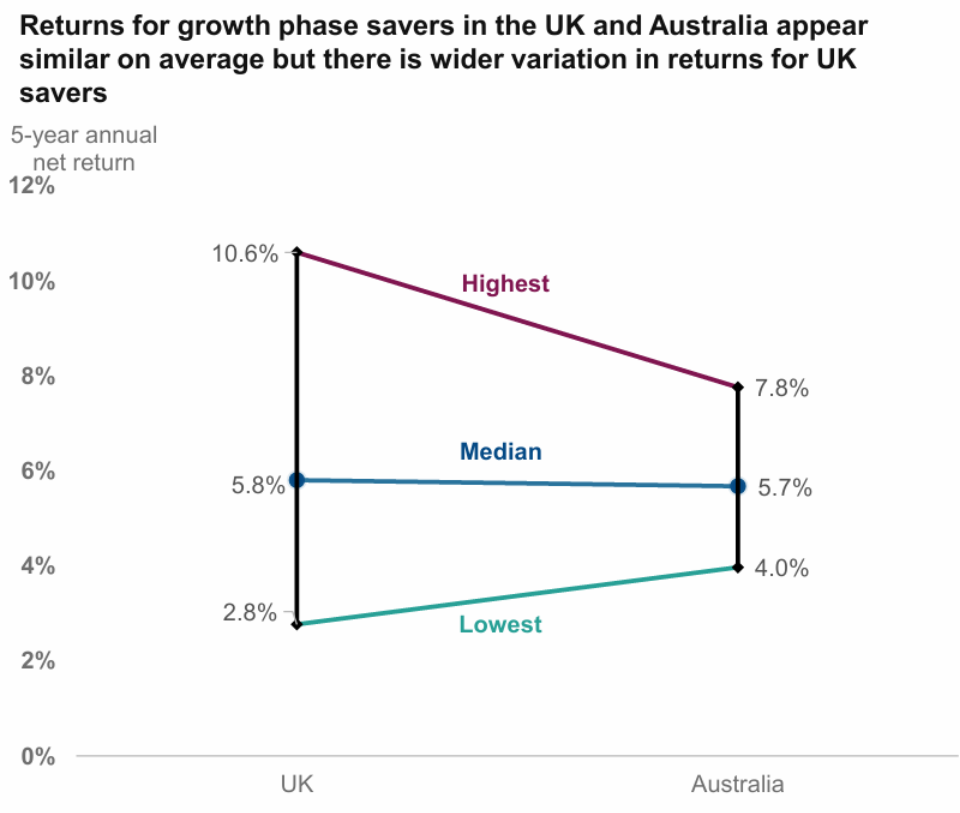
We are focusing on Australia here because it is considered to have one of the strongest pension systems in the world. If we step back far enough, average returns are broadly comparable. The key difference is the variation between what good and bad looks like in each country.
The graphic below shows just how much of a difference there can be.
The obvious implication is that UK employers need to have a stronger focus on investment oversight. That raises a worthwhile governance question for employers and trustees alike: When was your default arrangement last reviewed, and is it still well aligned to the needs and characteristics of your membership today?
Helping employees understand investment
Awareness of this amongst savers needs to improve, both for encouragement and reassurance.
A common question from members of pension schemes is what size of pension fund they should aim for. Whilst a fund of hundreds of thousands of pounds may be needed to provide a good level of retirement income, many multiples of annual salary as a target fund size can sound unattainable to many.
When something feels unattainable, we are less likely to take positive action. That is why correctly explaining the positive impact of compounding is so important when communicating investment and retirement saving to employees.
The takeaway for employers
Taken together, the interim report feels less like a call for dramatic short-term action and more like a prompt for careful review.
Three questions stand out:
- Do current contribution structures support adequate outcomes?
- Is the default fund still appropriate for your membership?
- Are employees receiving communication that genuinely helps them make informed decisions over time?
If there is a practical takeaway from this report, it may simply be that now is a good time to revisit some of the fundamentals. Contribution design, default strategy and employee communication can each have a meaningful effect over the long term.
The most useful employer response will be a thoughtful review of the decisions already within your control.
Are your employees on track for the retirement they expect?
The Pensions Commission’s findings suggest that participation alone is no longer enough. Reviewing contribution structures, default investments and member communications today could make a meaningful difference to the retirement outcomes your workforce achieves tomorrow.