


Securitised credit remains a small allocation for European insurers, but the regulatory backdrop is changing.
Today, securitisations represent less than 1% of EU insurers’ overall investment portfolios, compared with an estimated 4%–5% before the introduction of Solvency II. This is also well below the US where insurers’ securitisation exposure has been estimated at around 15% of total invested assets.1 Solvency II has been a key factor explaining this low allocation, given the capital charges applied to securitisation exposures. Under the standard formula, these exposures have historically attracted materially higher capital requirements than assets with similar credit characteristics, such as corporate bonds and covered bonds.
This has made the asset class difficult for European insurers to justify on a return on capital basis. Even where securitised credit offers diversification, structural protection and additional spread, the capital cost has often outweighed the investment case, particularly for insurers using the standard formula.
What’s changing?
The European Commission has adopted changes to the Solvency II rules that recalibrate the standard formula capital charges for securitisation exposures, with the new rules expected to apply from 30 January 2027. The UK is also reforming its Solvency UK and securitisation frameworks, and the broader direction of travel suggests a more proportionate and investment-supportive regime may follow.
Before considering the impact of the updated capital charges, it is useful to define the main securitised credit asset types. These include:
- Residential Mortgage-Backed Securities (RMBS): pools of residential mortgages exposed mainly to borrower default and prepayment risk.
- Commercial Mortgage-Backed Securities (CMBS): loans secured on commercial property such as offices, logistics or retail.
- Asset Backed Securities (ABS): consumer, auto, credit card or medium-sized enterprise (SME) loan pools. Risk centres on delinquencies and recoveries, with some structures revolving before amortising.
- Collateralised Loan Obligations (CLOs): portfolios of senior secured or leveraged corporate loans, driven by corporate default and recovery risk, plus reinvestment and manager-selection risk.
In a securitisation, “senior” refers to the tranche that ranks highest in the payment waterfall. Senior tranches are paid before subordinated tranches and typically absorb losses only after the junior tranches have been written down. This structural protection is one reason senior tranches can achieve high credit ratings, although the rating also depends on the quality of the underlying assets and the level of credit enhancement.
A further distinction is whether a securitisation is classified as STS (simple, transparent and standardised) or non-STS. It is a regulatory classification for securitisations that meet prescribed criteria around simplicity, transparency, disclosure and structural standardisation. Certain RMBS and simpler ABS transactions may qualify. By contrast CMBS and CLOs are generally excluded from the STS designation given their reliance on asset sales or active management features. A non-STS securitisation is not necessarily lower quality; it simply does not meet the STS criteria.
The revised rules are intended to make the capital treatment more risk-sensitive. The two key asset category types affected by the reforms are:
- senior tranches of non-STS securitisations
- securitisations with the STS designation
Standard formula capital charge changes
The most material change is for senior non-STS securitisations, which could include highly rated senior tranches of structures such as CLOs and CMBS.
These exposures have historically attracted high capital charges under the Standard Formula, even where the tranche is senior and highly rated. By way of example, under the revised rules, the capital charge for a 5-year duration AAA-rated senior non-STS tranche falls from 62.5% to 13.5%. Using a CLO capital structure as an illustrative example, the greatest benefit applies to the AAA senior tranche. Lower-rated CLO tranches in the illustration below are assumed non-senior and remain capital intensive even after the reforms. The Solvency Capital Requirement (“SCR”) charges shown below are calculated using the Standard Formula.
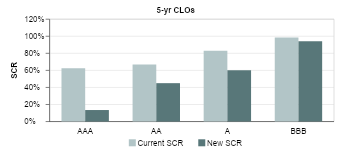
Source: European Commission, Broadstone calculations. Assumes 5-year modified duration. For illustrative CLO example, senior non-STS capital charge applied to the AAA tranche; non-senior non-STS capital charges applied to AA, A and BBB.
Senior STS securitisations also benefit, although the impact is smaller. Under the revised rules, for a 5-year duration AAA-rated senior STS exposure, the capital charge falls from 5.0% to 3.5%, while a BBB-rated senior STS exposure falls from 14.0% to 12.5%, with AA and A falling from 6.0% to 4.5% and 8.0% to 7.0% respectively. The smaller reduction reflects the fact that senior STS securitisations were already treated relatively favourably under the current rules, with charges calibrated closer to those for comparable corporate bonds than for non-STS securitisations. As with the earlier CLO illustration, “senior” here refers to a single top-ranking tranche whose achieved rating depends on the quality of the underlying pool and the level of credit enhancement.
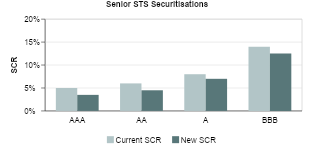
Source: European Commission; Broadstone calculations. Assumes 5-year modified duration. Senior STS capital charges applied across AAA, AA, A and BBB, reflecting the achieved rating of the senior tranche.
Illustrative return on regulatory capital
For insurers, one key consideration is whether the additional spread earned compensates adequately for the regulatory capital required to hold the asset. In the examples below, return on capital is calculated as spread divided by SCR, across a range of rating scenarios for both an illustrative CLO capital structure and senior STS exposures.
| CLO – 5yr | Illustrative | SCR | Illustrative return on regulatory capital | ||
| Rating | Spread (bps) | Current | Proposed | Current | Proposed |
| AAA | 150 | 62.5% | 13.5% | 2.4% | 11.1% |
| AA | 200 | 67.0% | 45.0% | 3.0% | 4.4% |
| A | 250 | 83.0% | 60.0% | 3.0% | 4.2% |
| BBB | 300 | 98.5% | 94.0% | 3.0% | 3.2% |
Source: European Commission, Broadstone calculations. Assumes 5-year modified duration. For illustrative CLO example, senior non-STS capital charge applied to the AAA tranche; non-senior non-STS capital charges applied to AA, A and BBB.
For the CLO structure, the reform’s benefit is heavily concentrated in the AAA senior tranche. The capital charge falls from 62.5% to 13.5%, increasing the return on regulatory capital from 2.4% to 11.1%. The benefit falls for the non-senior tranches: the AA tranche’s return on capital only rises from 3.0% to 4.4%, and the BBB tranche is largely unchanged, from 3.0% to 3.2%. In practice, the reform meaningfully repositions the senior tranche of CLO and CMBS-style structures but has a more limited impact on the economics of the subordinated tranches beneath them.
| Senior STS – 5yr | Illustrative | SCR | Illustrative return on regulatory capital | ||
| Rating | Spread (bps) | Current | Proposed | Current | Proposed |
| AAA | 50 | 5.0% | 3.5% | 10.0% | 14.3% |
| AA | 100 | 6.0% | 4.5% | 16.7% | 22.2% |
| A | 150 | 8.0% | 7.0% | 18.8% | 21.4% |
| BBB | 200 | 14.0% | 12.5% | 14.3% | 16.0% |
Source: European Commission; Broadstone calculations. Assumes 5-year modified duration. Senior STS capital charges applied across AAA, AA, A and BBB, reflecting the achieved rating of the senior tranche.
For senior STS exposures, the improvement is smaller but spread evenly across the rating spectrum, Return on capital rises at every rating band, from 10.0% to 14.3% at AAA, and from 14.3% to 16.0% at BBB.
Overall, the reform’s biggest shift sits at the top of the non-STS capital structure: senior non-STS tranche becomes significantly more attractive on a return on regulatory capital basis. Subordinated tranches beneath it see less of an improvement after the reform. For senior STS exposures, the case for investment improves steadily across the rating range, but the change is incremental rather than transformative.
Securitised credit within the fixed income allocation
Within the fixed income portfolio allocation, securitised credit can act as a complementary holding where the additional yield, diversification and structural protections justify the capital, liquidity and governance requirements involved.
- Additional spread: Senior securitised credit can offer a spread premium over similarly rated corporate bonds or covered bonds, reflecting the complexity of the asset class, lower secondary-market liquidity and the additional analytical work needed to assess collateral pools and waterfall structures.
- Diversification: The underlying exposures, residential mortgages, commercial property loans, auto loans, consumer credit, or SME lending, behave differently from a traditional corporate bond portfolio, and can reduce concentration to single-name corporate credit risk.
- Structural protection: Senior tranches benefit from subordination, over collateralisation, reserve accounts, excess spread and waterfall mechanics that absorb losses before they reach senior investors. These features reduce but do not remove the need for detailed due diligence and ongoing monitoring.
Conclusion
The Solvency II reforms will materially improve the capital treatment of selected securitisation exposures, particularly senior, highly rated non-STS tranches. The UK is also reforming its Solvency UK and securitisation frameworks, and the broader direction of travel suggests a more proportionate and investment-supportive regime may follow.
For insurers, the reforms create an opportunity to reassess securitised credit as part of a capital-aware fixed income allocation. At present, relatively few asset managers build securitised credit portfolios specifically designed for insurers, with reporting, capital treatment and portfolio constraints in mind. Many existing pooled fund structures have focused on STS strategies, reflecting their historically more favourable capital treatment. However, with the revised rules extending meaningful relief to senior non-STS tranches, investments in highly rated, senior CLO and CMBS tranches may become considerably more attractive on a capital-adjusted basis and can be combined with STS holdings to build a more diversified, capital-efficient portfolio.
As the capital case improves, insurers should expect to see a wider range of solutions brought to market offering capital-optimised access to securitised credit. That expansion is positive, but it also makes manager selection more important. Securitised credit remains a structurally complex and, at times, opaque asset class. Tranche seniority, collateral quality, underwriting standards, servicing arrangements and, for CLOs, manager tiering can all materially affect risk and return in ways that headline ratings do not fully capture.
This places a premium on robust portfolio design, fund research and manager due diligence, particularly as insurers assess the revised capital economics, compare manager capabilities and consider how securitised credit could fit within their own capital budget, liquidity needs, governance requirements and, where relevant, Matching Adjustment considerations. Insurers will also need to factor in the practical costs of implementation, including transaction costs and any model development or validation required. For internal model firms, material changes may also require regulatory engagement or approval.
Overall, the reforms do not remove the complexity of securitised credit, but they do improve the case for revisiting the asset class. For insurers prepared to undertake the necessary due diligence, selected senior securitised credit may offer a more compelling combination of spread, diversification and capital efficiency.
1 Source: Association for Financial Markets in Europe (AFME) Solvency II and Bank Capital Impact Analysis; AFME’s Response to the Commission’s Call for Evidence on the EU Securitisation Framework, March 2025