


By Matthew Downey, Senior Investment Consultant
A growing priority
The amount of money flowing into artificial intelligence (‘AI’) infrastructure is enormous. The AI ‘hyperscalers’ (Amazon, Microsoft, Alphabet, Meta and Oracle, with Alibaba dominant across Asia-Pacific) and now SpaceX are planning to spend hundreds of billions of dollars in the coming years on new computing capacity.
For institutional investors, this matters in two ways. First, exposure to AI companies and those who build data centres has increased across portfolios, through listed equities, infrastructure funds, private markets and asset-backed securities (ABS). This means that the associated environmental, social and governance (‘ESG’) risks linked to data centre operations are already a live concern. Second, they matter because the Pensions Regulator is clear that stewardship policies and responsibilities remain with trustees, even if they are implemented by the investment managers.
Even where regulation is less prescriptive, for DC governance committees, charities and wealth management clients, there are good reasons to understand the potential risk impact of data centres.
This paper explains what the ESG related risks are, what questions to ask your investment managers, and what good practice looks like.
The scale of the challenge
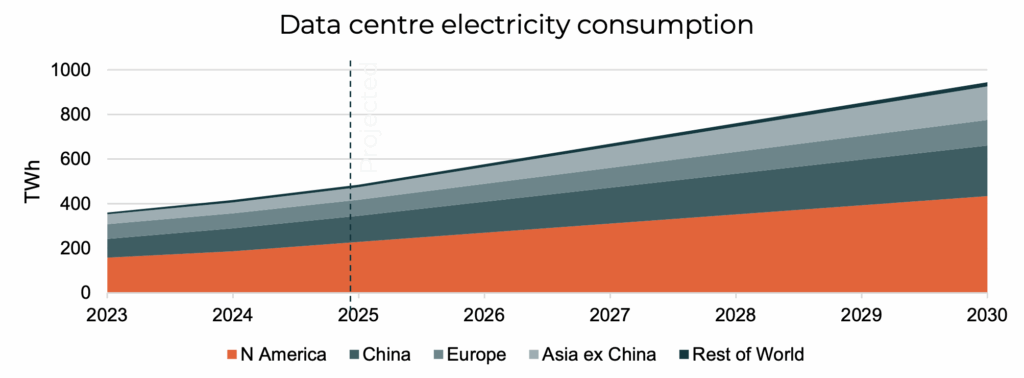
When we use AI on our phones or laptops, we rarely think of where all the necessary data is processed: ‘the cloud’ may sound remote or virtual, but in reality it is a network of data centres across the world. The energy consumed by these data centres is enormous. According to the International Energy Agency (IEA), they used about 415 terawatt-hours (TWh) of electricity globally in 2024, or 1.5% of the world’s total consumption. That figure is expected to more than double to around 945 TWh by 2030, roughly equivalent to Japan’s entire electricity use today.
It’s a similar story in the UK. At the end of 2024, Britain had approximately 1.6 gigawatts of data centre capacity. What is a gigawatt? For those who like 1980’s film classics, you may remember that Marty McFly needed 1.21 gigawatts of power in his DeLorean to get Back to the Future, but 1.6 gigawatts is enough to power over a million homes, with the data centres heavily concentrated within the M25 around London. That figure is set to double by 2030 and to give you a sense of scale, that is about the peak energy output of three nuclear power plants.
At the individual data centre level, Elon Musk’s firm xAI (now part of SpaceX) has a data centre ‘Colossus 1’, which uses enough energy to power 100,000 homes. xAI is planning a much larger centre (‘MacroHardrr’, and no, that is not a typo), which is expected to use twenty times that.
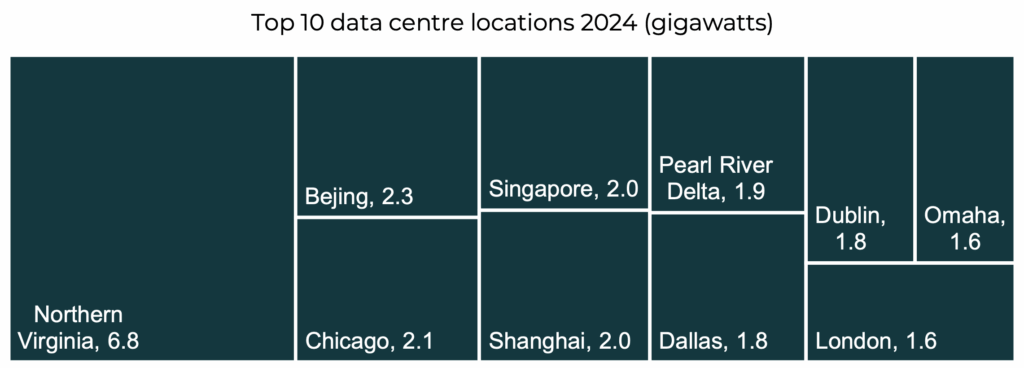
The following chart shows the concentration in key locations already, with significant further development in those locations and elsewhere planned in the coming years.
To understand the appetite for energy, consider this: asking your favourite AI agent to generate an image or an exercise plan for the gym uses about the same electricity as heating a piece of toast. The semiconductor chips needed to do this work also produce heat, so need to be cooled by water or air. Individually that doesn’t sound like much, but multiplying that across millions of daily interactions and you can see that the cumulative demand for energy and water is vast.
To deliver that power to data centres, the first option is often using power from the electricity grid, but that is far from straightforward. Depending on location, connecting to the grid can take up to seven years and in some places, the queue to link up to the grid has closed entirely. Dublin has even banned new connections until 2030. To bridge this gap, data centre operators have to supplement energy supply with onsite power generation: at one end of the carbon spectrum, using solar panels and wind turbines, while at the other end, using gas-fired generators and, in parts of China, coal-fired power plants. Microsoft is even planning some of its energy supply via nuclear power because of the low carbon emissions, with plans to reopen Three Mile Island in Pennsylvania.
The result is a data centre sector which is growing enormously but constrained by physical infrastructure. This creates significant challenges across the traditional headings of Environmental, Social and Governance.
Environmental
Carbon is the most obvious issue. It’s estimated that one proposed data centre in Lincolnshire will produce five times the greenhouse gas emissions of Birmingham Airport, even including take-offs and landings.
When measuring carbon emissions, this is split between Scope 1 (generated on-site), Scope 2 (energy bought from external sources) and Scope 3 (all the other sources across a company’s value chain). The semiconductor chips and hardware inside data centres carry significant embedded carbon within their Scope 3 emissions. NVIDIA, which supplies the majority of AI GPU chips, has set carbon reduction targets but these are measured per unit of computing power rather than in absolute terms. As volumes increase, absolute emissions rise even as per-chip energy efficiency improves.
Water is the other environmental constraint. The processors in data centres generate an enormous amount of heat, and cooling them often needs large amounts of water. Google has highlighted that one of its data centres in Iowa uses 3.4 billion litres a year, about the same as all the bottled water sold each year in the UK.
What about putting data centres in space I hear you ask? Musk (and others) have talked about the possibilities of harnessing solar radiation to generate energy needed for AI. However, the Carbon Trust recently published an article explaining the associated issues of:
- Carbon emissions. Launching each SpaceX Starship emits around 3,500 tonnes of CO2, about the same as a 3,500 return flights from London to New York and would potentially need hundreds, if not thousands of trips. SpaceX has asked for permission to launch 1 million satellites,
- Cost. Each rocket launch costs about $90m, and
- Ongoing maintenance and processor lifespan. The GPU chips have a likely workable life of 1-3 years so would then somehow need to be replaced.
Social
Data centres are frequently presented as benefiting the country or region where they are located. At a national level, that may be true as the scale of data centre investment has benefitted economic (GDP) growth in recent years. However, the benefits rarely flow to local communities in proportion to the disruption caused. Residents living nearby face noise from generators and cooling systems, competition for local power and water, but only benefit from limited direct employment.
Some operators have explored feeding surplus heat to nearby homes, which is a sensible idea in principle. In practice though, data centres produce heat continuously, while demand from households fluctuates with the seasons and the time of day. Matching the two has proven more difficult than it sounds, with excess heat often going to waste.
AI chips also rely on rare earth minerals from supply chains from across the world. Labour standards and environmental practices in the extraction process are an area where investors should expect oversight from their investment managers.
Governance
Several of the largest AI companies have made ambitious public commitments on climate in the past. Alphabet (Google) has committed to be net-zero by 2030, while Microsoft has pledged to be carbon negative by 2030. It has also promised that by 2050 it will have eliminated all the carbon it has emitted since its founding in 1975. Microsoft’s goal is far more demanding than normal carbon offsetting, which reduces future emissions but does not remove historical ones from the atmosphere.
Those targets were set before the current wave of AI-driven energy demand. Microsoft’s Chief Sustainability Officer acknowledged the difficulty in a blog post last year: ‘In 2020, Microsoft leaders referred to our sustainability goals as a “moonshot,” and nearly five years later, [because of AI] we have had to acknowledge that the moon has gotten further away’.
The governance question is not whether companies set targets, but whether those targets are still credible, externally verified, and importantly whether boards are being held accountable when they slip.
Asking the right questions
These sustainability risks require a structured approach to engagement with investment managers. The questions below can be applied across the portfolio, with more scrutiny directed at holdings with significant exposure to AI hyperscalers.
Environmental:
- What percentage of energy comes from renewable sources now, and how will that change by 2030? Crucially, is renewable energy matched across the year, or on an hourly basis. The latter is significantly more demanding and expensive than matching annual averages.
- What is the Power Usage Effectiveness (PUE) of the data centres? PUE measures total energy use of the facility, as a proportion of the energy consumed by IT equipment alone. A score of 1.0 would be perfect efficiency, while recent averages are about 1.55. This is higher than the targets set by the EU Climate Neutral Data Centre Pact, whose targets are shown in the table below.
- What is the Water Use Effectiveness (WUE)? Where is water sourced? What strategies are in place to reduce consumption, particularly in water-stressed regions?
- Amazon Web Services, Microsoft and Google have all committed to be water positive by 2030, replenishing more water than they use. Are these targets still achievable?
Note that PUE and WUE should be read together, as data centres can either use air or water as coolants, so reducing one typically increases the other.
The EU Climate Neutral Data Centre Pact (with over 100 signatories) sets out what best practice looks like:
| Metric | Target |
| Power usage effectiveness (PUE) | New centres: PUE of 1.3 in cool climates and 1.4 in warm climates. Existing centres to meet the same targets by January 2030. |
| Renewable energy | 100% of electricity demand matched by renewable or carbon-free energy on an hourly basis by December 2030 (75% by December 2025). |
| Water use Effectiveness (WUE) | Maximum 0.4 litres per kWh in areas of water stress. |
Social:
- How are firms managing local planning issues and potential community resistance? Are there examples of meaningful community benefit, or are these largely public relations exercises?
- AI chips rely on rare earth minerals from global supply chains. How are suppliers audited to ensure acceptable labour and environmental practices?
- Where excess heat is claimed as a benefit to communities, has actual delivery been tested against real demand patterns? Is surplus heat being wasted?
Governance:
- Is sustainability at the data centres owned at Board level, by an individual or a sub-committee with clear accountability? What happens if targets are missed?
- Have firms signed up to the Science-Based Target initiative (SBTi) or similar to reduce carbon emissions over time? If so, are these externally verified?
- Are companies still on track to meet their commitments, or are targets being quietly revised? For example, Google’s total emissions increased between 2020 and 2024, with Scope 3 rising the fastest.
Issues to watch and manager engagement
We have researched investment managers who incorporate these factors well, across liquid assets and infrastructure funds and aim to benefit from potential opportunities. Some are engaging with AI hyperscalers on these ESG issues, particularly as they relate to increased risk of litigation or other financially material impacts on the underlying firms. That said, while the managers may have ‘red lines’ in terms of acceptable standards, in recent years the engagement is now often nuanced: for example if gas generators are used to power data centres, investment managers may ask if this is a temporary or backup measure, rather than engaging to remove these outright.
When speaking to managers, investors should look out for three things in particular:
Renewable energy claims and reality. Matching energy use to renewable generation on an hourly basis, as Google and Microsoft have committed to do, is much more complex and expensive than matching across the annual average. It requires battery storage and a carefully managed mix of sources to smooth supply which varies throughout the day. Investment managers who cite renewable credentials of underlying firms, but without specifying if it is hourly matched may be reporting something which is much less demanding.
The gap between ambition and accountability. Microsoft’s 2025 update was notable for its honesty in admitting that AI had made its climate targets even harder to achieve. Not every company will be so transparent so investors should ask not only whether targets exist, but whether they are being revised openly or simply allowed to drift.
Regulatory risk. At the extreme end, xAI has been accused of violating the US Clean Air Act by exploiting a loophole in regulation. It has been accused of using dozens of bus-sized methane generators to power the new data centres, with potential impacts on local air quality as well as on carbon emissions. Regulatory crackdowns or planning restrictions could create financial risk for companies operating at the margins of compliance.
Trustee actions
Here are our recommended actions for different institutional investors:
| Investor | Recommended action |
| DB pension schemes | Initial fact-finding to explore exposures within growth assets: ‘ESG-friendly’ funds typically have higher allocations to technology firms so may have greater data centre exposure.Ask if Task Force on Climate-related Financial Disclosure (TCFD) reporting accurately captures the impact of data centres, or if it is included within voluntary Scope 3 emissions. Embed specific expectations, including on PUE, WUE, renewable energy matching and governance accountability, into investment manager mandates. Ask for evidence that voting and engagement policies have been updated to reflect the importance of data centres, with particular focus on AI hyperscalers. |
| DC schemes & IGCs | Raise data centre ESG exposure in Chair Statements and IGC value-for-money assessments. Include data centres in the assessment of default fund ESG credentials, particularly where there is private markets or infrastructure allocations. Challenge the investment managers of the default approach to provide specific stewardship reporting on AI hyperscalers. |
| Charities | Identify exposure to AI hyperscalers across the portfolio. Include data centres within any existing responsible investment or climate policies. Seek confirmation from investment managers that stewardship policies specifically address AI-related ESG risks. |
The broader point is that stewardship in general and for data centres in particular is good investment governance. The hyperscalers’ ability to manage energy costs, secure grid connections, maintain their licence to operate in local communities and deliver on their public climate commitments will shape their long-run economics. Investors who ask the right questions now will be better placed to assess those risks as they evolve.
Conclusion
AI and the associated data centres are a growing part of investment portfolios across asset classes. If poorly managed, these can attract significant sustainability issues, which could be financially material. Investors should therefore ask their investment managers to engage with datacentre providers to improve the range of sustainability risks, and monitor how these evolve over time.
Important information: This article is provided for information purposes only and does not constitute investment, legal, tax, regulatory or other professional advice, nor a personal recommendation. The views expressed are those of the authors at the time of writing and may change without notice. Any forward-looking statements reflect current expectations and are subject to change. References to specific companies or investment managers are for illustrative purposes only and should not be regarded as endorsements.